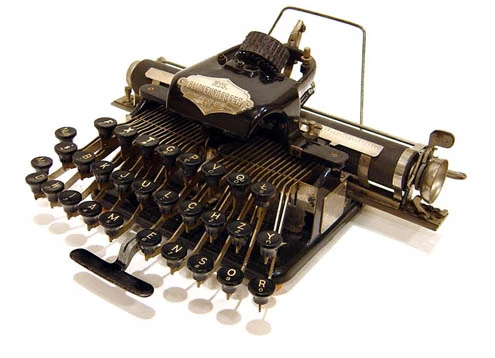
The Typewriter
Built so one blind woman could write a legible letter.
Read case study →Guiding questionHow do designers design mainstream products and environments that are accessible and attractive to the largest possible number of people?
Inclusive design starts from a claim that sounds obvious and turns out to be radical: disability is not a property of a person, it is a mismatch between a person and an environment somebody designed. A building with stairs and no ramp does not accommodate a wheelchair user badly. It excludes them, and it does so because of decisions that could have gone another way at little cost had anyone thought about it early enough.
The practical case is easy to make and worth making. Curb cuts were fought for by wheelchair users and are now used by anyone with a suitcase, a pram or a delivery trolley. Captions were built for deaf viewers and are now switched on in half the world's living rooms. Designing for the edges of a user population tends to improve the product for the middle, which is why "design for extremes" appears here as a strategy rather than an act of charity. Pay particular attention to objective 1.2.2, which admits that inclusive design is not always possible. Being able to say clearly where the limits are and why is a far more sophisticated answer than insisting everything can be made universal. This topic also connects tightly back to the percentile and physiology work in A1.1.
Students must be able toDiscuss how inclusive design requires designing universally accessible products for all users, including those with physical, sensory and cognitive impairments.
Inclusive design (also called universal design, accessible design, or design for all) is an approach that removes barriers and ensures products and environments are usable by everyone, regardless of age, ability, or physical or cognitive difference. The goal is mainstream products that work for all users, not a parallel range of "special needs" versions that stigmatise users and add cost.
The term Universal Design was coined by architect Ron Mace in 1985. The Centre for Universal Design at North Carolina State University defines it as: "the design of products and environments to be usable by all people, to the greatest extent possible, without the need for adaptation or specialised design."
Inclusive design extends User-Centred Design (UCD) by deliberately including community members who might otherwise be overlooked: the elderly, pregnant women, people with disabilities, and those who are temporarily injured. The seven principles of Universal Design are:
Legislation: Many countries legally require designers to consider users with disabilities:
Built so one blind woman could write a legible letter.
Read case study →Students must be able toDiscuss how the average person correlates to the 50th percentile adult and child, and how it is not always appropriate to design for the average person.
The average adult and the average child
When people talk about designing for "the average person", they usually mean the 50th percentile: the measurement that half the population falls below and half above. But there is no single average person. The 50th percentile adult and the 50th percentile child are very different bodies. Using the global figures in the height curve in A1.1.2, the average adult man is about 168 cm tall and the average adult woman about 156 cm, while the World Health Organization's growth reference puts the average eight-year-old at about 127 cm. A drinking fountain, handrail or ticket machine set for the average adult is out of reach for the average child, and one set for the average child is awkward for most adults.
Even within one group, the average fits almost nobody. A person of average height can have long arms, a short back or wide shoulders, so someone who is 50th percentile in every body dimension at once is extremely rare. A product built to the average in every dimension fits a few people well and a great many people slightly badly. A1.1.3 and A1.1.5 explain why in more detail.
When designing for the average makes sense
The average is still useful when getting a dimension slightly wrong causes inconvenience rather than exclusion. Kitchen worktops, supermarket checkout counters and door handles are usually set close to an average adult dimension. A very tall or very short user finds them a little less comfortable, but can still use them. The average becomes the wrong choice when a dimension decides whether someone can use the product at all, such as the reach to an emergency stop button or the clearance under a doorway. Those dimensions are set at the 5th or 95th percentile instead.
Why inclusive design is not always possible
Even when designers set out to include everyone, three kinds of limit get in the way.
The first is the edge of the range. Most products are designed for the 5th to 95th percentile, which leaves around 10% of people outside it. Users far beyond that range, such as a very tall adult or a person of restricted growth, usually need a specialist or adapted product. That is a deliberate decision rather than an oversight, and a designer should be able to say where the line is drawn and why.
The second is conflicting needs, where what helps one group gets in the way of another. At a pedestrian crossing, wheelchair users and people pushing prams need the kerb dropped flush with the road. A blind person using a cane, however, relies on the edge of the kerb to know where the pavement ends, so removing it takes that information away. The usual answer is a dropped kerb covered in blister tactile paving that a cane or foot can feel, but the raised bumps are uncomfortable for some wheelchair users and people with walking difficulties. Every option is a compromise between groups.
The third is cost and practicality. Including a wider range of people means more adjustments, more sizes or more features, and each one adds cost, weight or complexity. At some point the extra cost outweighs the benefit to the small number of extra people included, and the designer has to decide where to stop.
Students must be able toDiscuss the advantages of designing for extremes when designing products for a general population, and identify where a design for extremes strategy has been used.
Most design starts in the middle: who is the typical user, and what do they need? Design for extremes starts at the edges instead. The designer picks the users whose needs are hardest to meet, often people with a physical, sensory or cognitive impairment, and designs for them first. Again and again, the result turns out to work better for everyone else too.
That pattern has a name. Kerb ramps, the small slopes cut into pavements at crossings, were campaigned for by wheelchair users in the 1970s. Today they are used all day by people with prams, suitcases, delivery trolleys and bicycles, most of whom never think about why the ramp is there. The curb-cut effect describes what happened: a solution built for the hardest case improved the pavement for the whole population.
The method of extremes designs for the ends of the user population rather than the average. Instead of asking what the typical user can do, you ask what the largest and the smallest user need, then design so that both are accommodated. The mean is used alongside these two limits.
The convention is to apply each extreme where it does the most good. Doorways, ladders, step heights and escape hatches are sized on the 95th percentile of males, because clearance has to work for the largest user. The force required to operate a control button is set by the 5th percentile of females, because if the weakest user can press it, everyone can. Together these choices accommodate the largest possible number of people.
By its nature, this approach still excludes anyone falling beyond the extremes that were chosen. That is why designing for extreme users often means prioritising people with disabilities, whose needs sit outside the able-bodied range entirely. Doing so reliably produces better designs for everyone, and it is the point where the method of extremes shades into universal design, which aims for products usable by all people without adaptation.
The method also shapes user research. When you plan research in B1.1.2, it is a reason to recruit participants from the ends of the population as well as typical users, because the people at the edges are the ones a design is most likely to let down.
Shoes you never have to touch
In 2012, Matthew Walzer, a 16-year-old with cerebral palsy, wrote to the chief executive of Nike. He could not tie his own laces, and he wanted to go to university without needing someone to tie his shoes every day. Nike designer Tobie Hatfield worked with him on the problem, and the result became the FlyEase range. Its most radical version, the GO FlyEase (2021), has no laces at all. A bistable hinge in the sole, a hinge that is stable both fully open and fully closed, holds the shoe open until the wearer steps in, and the step closes it. A kickstand at the heel lets the wearer step back out by pressing it with the other foot, the same move many people already use to kick off a pair of trainers. A shoe designed for someone who cannot bend down or use their hands also suits a parent carrying a toddler, someone with a bad back, and anyone in a hurry.
Subtitles for people who can hear
Subtitles and closed captions were developed so that deaf and hard-of-hearing viewers could follow television and film. They are now switched on in living rooms everywhere by people who hear perfectly well. A 2023 YouGov survey found that 61% of 18 to 24-year-olds in the UK use subtitles when watching TV and films, often to follow quiet dialogue or strong accents, or to keep the volume down while someone else is asleep. Designing for viewers who could not hear the soundtrack produced a feature for anyone who cannot hear it clearly at that moment.
Handles instead of knobs
A round doorknob has to be gripped and twisted, which is difficult or impossible for someone with arthritis, weak hands or a hand that does not close. A lever handle only needs to be pushed down, and that can be done with a closed fist, an elbow or a wrist. Accessibility guidance in many countries now recommends or requires lever handles in public buildings for exactly this reason. The same handle helps anyone carrying shopping, a baby or a tray, and anyone whose hands are wet or covered in paint.
The electric toothbrush
The first practical electric toothbrush, the Broxodent, was invented in Switzerland in 1954 by Dr Philippe-Guy Woog. It was designed for patients with limited motor skills, who could not make the small, quick movements that clean teeth properly, and for patients wearing orthodontic braces. A motor made those movements for them. Electric toothbrushes are now ordinary bathroom products, used by millions of people who have no difficulty brushing at all.
Voices that read aloud
Text-to-speech (TTS) software reads digital text aloud. It was developed for people with visual impairments and people with dyslexia, users for whom reading a screen is slow, tiring or impossible. That hard constraint forced designers to rethink how a person and a device communicate, without relying on a screen at all. Voice assistants built on the same technology, such as Siri, Google Assistant and Alexa, are now used by millions of people without any impairment to send a message while driving, set a timer while cooking, or check the weather with their hands full.
Why starting at the edges works
Each of these stories follows the same pattern. An extreme user brings a hard constraint, such as no grip, no hearing or no way to bend down, and a hard constraint cannot be met by tweaking the existing design, so it forces a genuinely new solution. Because that solution works for the person with the greatest difficulty, it also works for people with less difficulty, which is everyone else. And because populations are ageing, and anyone can be injured or have their hands full for a while, today's extreme user is a preview of tomorrow's ordinary one.
The examples above will soon be the ones everyone in your class reaches for. That familiarity is a trap: repeating a well-known example in an exam answer shows you have memorised a list. Explaining why a particular constraint forced a better design shows you understand the strategy.
Find your own example: a product or feature originally built for a specific impairment that you or people around you now use without a second thought, and be ready to explain why the extreme constraint, rather than a general wish to be inclusive, forced a better design. Then find a counter-example: a case where designing for an extreme user made the product worse for everyone else, or where a company bolted on an "accessibility feature" that didn't actually solve the real problem. What separates the two?
Ten questions covering Universal Design principles, percentile ranges, legislation and the design for extremes strategy. Select one answer per question, then click "Check all answers" to see your score and the explanations.
Tactile paving is a surface laid into a pavement whose raised pattern can be read through a shoe sole or a long cane. Different patterns carry different meanings, and the system was developed in Japan in 1965 before being adopted internationally.
Table 1: Three tactile paving patterns
| Pattern | Form | Meaning |
|---|---|---|
| Blister | Flat-topped domes, 25 mm across, 5 mm high | Road crossing ahead, kerb removed |
| Corduroy | Rounded bars across the direction of travel | Hazard: steps, level crossing, ramp |
| Lozenge | Flat-topped diamonds | Platform edge on a light rail line |
The patterns are laid in a colour contrasting with the surrounding pavement.
(a) State the limiting aspect of user capability that tactile paving is designed to address, see Table 1. [1]
(b) Outline why the three patterns in Table 1 differ in form rather than only in position. [2]
(c) Explain how tactile paving benefits users beyond the group it was designed for, see Table 1. [3]
(a) Visual accuracy, including low vision and blindness.
(b) A user reading the surface through a cane or a shoe sole receives only the pattern, with no context to tell them which hazard it refers to, so the meaning has to be carried by the form itself. Distinct shapes let one surface encode several different warnings, and the difference between domes, bars and diamonds is large enough to be told apart through a shoe sole, which a difference in position would not be.
(c) The paving is a tactile signal and a visual one at the same time, so anyone can use it. The colour contrast marks a crossing point for a sighted pedestrian looking at a phone, and for a driver it makes the crossing visible from the road. The corduroy pattern warns of steps underfoot, which is useful to someone carrying a box they cannot see past, a parent pushing a buggy or a person in an unfamiliar station in a hurry. Removing the kerb at a blister crossing is the clearest case, because it was done so that a wheelchair user could cross, and it now serves buggies, suitcases, delivery trolleys and anyone with a walking aid. This is the general pattern in inclusive design: a solution developed for people at the extreme of a capability range removes effort for everyone in it.
(a) • Visual accuracy ✓
• Sight loss / blindness / low vision ✓
Award [1] for the correct limiting aspect of user capability up to [1 max].
(b) Inclusive design ensures products address the needs of the widest possible audience regardless of age or ability.
• The user receives only the pattern, with no context to identify the hazard ✓
• The meaning must be carried by the form itself ✓
• Distinct shapes let one surface encode several different warnings ✓
• Domes, bars and diamonds are distinguishable through a shoe sole or cane tip ✓
• Position cannot be perceived by a user who cannot see the layout ✓
• Different hazards need different responses, so they must be separable ✓
• A single pattern in different places would be ambiguous ✓
Award [1] for each relevant brief point on why the patterns differ in form up to [2 max].
(c) Designers often use a design for extremes strategy to develop solutions suitable for those with impairments which are also appropriate for the general population.
• The paving carries a tactile and a visual signal at once, so any user can read it ✓
• Colour contrast marks a crossing for a distracted sighted pedestrian ✓
• It makes the crossing point visible to a driver from the road ✓
• Corduroy warns of steps underfoot to someone carrying a box they cannot see past ✓
• Useful to a person in an unfamiliar station moving quickly ✓
• Removing the kerb for a wheelchair user also serves buggies, suitcases and trolleys ✓
• It benefits anyone using a walking aid or with reduced mobility ✓
• It works in darkness and poor weather, when everyone's visual accuracy is reduced ✓
• A solution designed for the extreme of a capability range removes effort across the whole range ✓
Award [1] for each relevant reason / cause explaining how the paving benefits users beyond the intended group up to [3 max]. Award a maximum of [2] where the response gives examples without identifying the design for extremes principle.
A kettle is filled at a tap and poured into a cup. A full 1.7 litre kettle weighs about 2.3 kg, and pouring requires it to be lifted, tilted and held steady over a small target.
A manufacturer developed an alternative: a fixed reservoir stays on the worktop and dispenses a measured volume into a cup placed beneath it at the press of a button. Nothing is lifted.
Table 2: Force and grip demands compared
| Task | Conventional kettle | Dispenser |
|---|---|---|
| Mass lifted | 2.3 kg | 0 kg |
| Grip required | Sustained, one hand on handle | Momentary press |
| Held steady for | 6–10 s while pouring | 0 s |
| Consequence of a slip | Scald | None |
| Worktop area used | 0.03 m² | 0.06 m² |
| Price | £30 | £130 |
(a) State one limiting aspect of user capability that makes pouring a full kettle difficult, see Table 2. [1]
(b) Identify two groups of users for whom the consequence of a slip in Table 2 is most serious. [2]
(c) Analyse why the dispenser has not replaced the conventional kettle despite its advantages, see Table 2. [3]
(a) Reduced strength, since 2.3 kg must be lifted and held away from the body.
(b) Older users with reduced grip strength or tremor, and users with a condition affecting muscle control such as arthritis or Parkinson's.
(c) The dispenser is better on every measure of capability and worse on the measures that drive a purchase. It costs more than four times as much, and a kettle is a product most people replace only when the old one fails, so a £130 device competes against a £30 one that most buyers regard as adequate. It also takes twice the worktop area in the room where space is most contested, which is a real cost in a small kitchen. The deeper obstacle is that the benefit is invisible to the person choosing. Someone with full grip strength does not experience pouring a kettle as difficult, so the dispenser appears to solve a problem they do not have, and inclusive design features are typically bought only once the buyer needs them. That produces a market where the product is positioned as specialist equipment rather than as a kettle, which narrows its sales, keeps its volume low and holds the price high, so the cost barrier and the perception barrier reinforce each other.
(a) Students must be able to explain limiting aspects of user capabilities, including visual accuracy, colour perception, strength, fatigue, muscle control and hearing thresholds.
• Reduced strength ✓
• Reduced grip strength ✓
• Reduced muscle control / tremor ✓
• Fatigue ✓
Award [1] for one relevant limiting aspect of user capability up to [1 max].
(b) • Older users with reduced grip strength ✓
• Users with arthritis or a condition affecting muscle control ✓
• Users with a tremor, for example from Parkinson's ✓
• Children ✓
• Users with reduced sensation who would not react quickly to a scald ✓
• Wheelchair users, for whom spilled water falls onto the lap ✓
• Users with low vision who cannot see the cup precisely ✓
Award [1] for each relevant group identified up to [2 max]. Do not credit two descriptions of the same group.
(c) Inclusive design is not always possible, and commercial factors limit its adoption.
Cost:
• £130 against £30 is more than four times the price ✓
• A kettle is usually replaced only when the old one fails, so the comparison is against a working product ✓
• Most buyers regard the conventional kettle as adequate ✓
Space:
• Twice the worktop area, in the room where space is most contested ✓
Perception:
• A user with full grip strength does not experience pouring as difficult ✓
• The dispenser appears to solve a problem the buyer does not have ✓
• Inclusive features are typically bought only once the buyer needs them ✓
• Buyers may not anticipate their own future needs ✓
Market effects:
• Positioning as specialist equipment narrows the market ✓
• Low volume keeps unit cost and price high ✓
• The cost barrier and the perception barrier reinforce each other ✓
• Being marked out as a product for disabled users deters buyers who do not identify that way ✓
Award [1] for each distinct guiding element / structure identified in why the dispenser has not replaced the kettle up to [3 max]. Award a maximum of [2] where the response argues only from price.
A cinema chain is refurbishing a screen. The auditorium seats 240 in a raked layout, with a single accessible row at the back reached from the entrance corridor. Wheelchair spaces are provided by removing two seats at the end of that row.
(a) Identify two ways the current wheelchair provision limits the experience compared with other seats. [2]
The chain offers three accessibility features, each on selected screenings.
Table 3: Accessibility screenings offered
| Feature | How it works | Availability |
|---|---|---|
| Subtitled screening | Captions burned into the picture, visible to all | 1 screening per film per week, usually weekday afternoon |
| Audio description | Narration of on-screen action through a headset | Any screening, headsets from the desk |
| Relaxed screening | Lights raised, sound lowered, free movement permitted | 1 screening per month |
(b) Outline why the availability of the subtitled screening limits its usefulness, see Table 3. [2]
Audio description is delivered through a headset issued at the desk. Subtitles are burned into the picture for everyone in the auditorium.
(c) Describe why audio description can be offered at any screening but subtitles cannot, see Table 3. [2]
The chain is considering personal subtitle glasses that display captions to the wearer alone, allowing any screening to be subtitled. They cost €900 a pair, need charging and cleaning between uses, and some users report eye strain.
(d) Evaluate the subtitle glasses as a solution to the problem identified in Table 3. [4]
(a) The viewing position is fixed at the back with no choice of where to sit, and a wheelchair user cannot sit among a group of friends because the spaces are at the end of one row.
(b) One weekday afternoon screening a week means the film can only be seen at a time most people are at work or school, so access is granted in principle and withdrawn in practice. It also removes the social element, since a deaf viewer cannot go with hearing friends at a time that suits them and cannot see a film on its opening weekend when everyone else does.
(c) Audio description is delivered to one person through a headset, so it changes nothing for anyone else in the auditorium and can therefore run at every screening at no cost to other viewers. Subtitles are burned into the shared picture, so switching them on changes the film for all 240 people, and because some viewers object the cinema treats a subtitled screening as a separate event rather than as a default.
(d) The glasses solve the structural problem precisely. The reason subtitles are rationed is that they are shared, and the glasses make them personal, which means any screening becomes accessible: opening weekend, evening showings, a birthday outing with hearing friends. That converts subtitling from a scheduled concession into a property of every screening, and it is the choice of when to attend, rather than the captions themselves, that the current arrangement denies.
Against that, the solution repairs the exclusion while preserving its shape. The deaf viewer alone has to collect equipment from a desk, wear something visible, and depend on it having been charged, none of which a hearing viewer does, so the burden stays with the person who was already excluded. Kit-based access also fails in ways scheduled access does not: an uncharged or unavailable pair means no film at all that evening, whereas a fixed weekly screening at least happens.
The cost is significant. At €900 a pair a cinema will hold few, so a group of deaf friends may not all be served at one screening, and the eye strain some users report means the device does not suit everyone in the group it targets.
On balance the glasses are worth adopting but not as the whole answer. They deliver the freedom of choice that matters most and should be introduced, while the weekly burned-in screening is retained for viewers the glasses do not suit and for those who prefer not to wear a device. The strongest inclusive solution would be to increase burned-in subtitled screenings as well, since that is the only version where nobody has to identify themselves or carry anything.
(a) Inclusive design focuses on designing universally acceptable products for all users.
• No choice of viewing position; the seat is fixed at the back ✓
• Cannot sit among a group of friends or family ✓
• Viewing angle and distance are the same regardless of preference ✓
• Provision depends on two seats being removed, so it is conditional ✓
• Being placed at the end of a row marks the user out ✓
• Cannot book the seats other viewers regard as the best ✓
Award [1] for each relevant limitation identified up to [2 max].
(b) Inclusive design ensures products address the needs of the widest possible audience regardless of age or ability.
• One screening a week, usually on a weekday afternoon ✓
• Most potential viewers are at work or school at that time ✓
• Access is granted in principle and withdrawn in practice ✓
• The viewer cannot attend with hearing friends at a time that suits them ✓
• The film cannot be seen on its opening weekend ✓
• The choice of when to attend is removed, which other viewers keep ✓
• A single screening cannot absorb demand from the whole deaf audience ✓
Award [1] for each relevant brief point on why the availability limits usefulness up to [2 max].
(c) • Audio description reaches one person through a headset ✓
• It changes nothing for other viewers, so it costs them nothing ✓
• It can therefore run at every screening without scheduling ✓
• Subtitles are burned into the shared picture ✓
• Switching them on changes the film for all 240 viewers ✓
• Some viewers object, so the cinema treats it as a separate event ✓
• The difference is whether the accommodation is personal or shared ✓
Award [1] for each detail, leading to an account of why the two features differ in availability, up to [2 max]. The response must identify the personal against shared distinction for full marks.
(d) Inclusive design is not always possible; solutions must be appraised against the needs of the whole user population.
Strengths:
• Makes subtitles personal, which removes the reason they are rationed ✓
• Any screening becomes accessible, including evenings and opening weekend ✓
• Restores the choice of when to attend, which is what the current arrangement denies ✓
• Allows a deaf viewer to attend with hearing friends at a time that suits everyone ✓
• Converts subtitling from a scheduled concession into a property of every screening ✓
• No effect on other viewers, so no objection to manage ✓
Limitations:
• The deaf viewer alone must collect, wear and rely on equipment ✓
• The burden stays with the person already excluded ✓
• Wearing a visible device identifies the user as needing an adjustment ✓
• An uncharged or unavailable pair means no film at all that evening ✓
• At €900 a pair a cinema will hold few, so a group may not all be served ✓
• Reported eye strain means the device does not suit everyone in the target group ✓
• Requires charging and cleaning between uses, adding an operational failure point ✓
Judgment:
• Worth adopting, but not as the whole answer ✓
• The weekly burned-in screening should be retained for those the glasses do not suit ✓
• Increasing burned-in screenings is the only version where nobody must identify themselves or carry anything ✓
Award [1] for each distinct strength / limitation, leading to an appraisal of the subtitle glasses, up to [4 max]. Award a maximum of [3] where only strengths or only limitations are given. Credit responses that distinguish personal from universal solutions.
Linking Questions
Around 1808, an Italian inventor named Pellegrino Turri built a writing machine for a close friend, Countess Carolina Fantoni da Fivizzano. She had lost her sight and could no longer write a letter anyone else could read. There was no real market for it, just a goal to help someone who couldn't see write letters without help. Several of the Countess's letters, typed on Turri's machine, survive today. Unfortunately the machine itself has been lost to history.
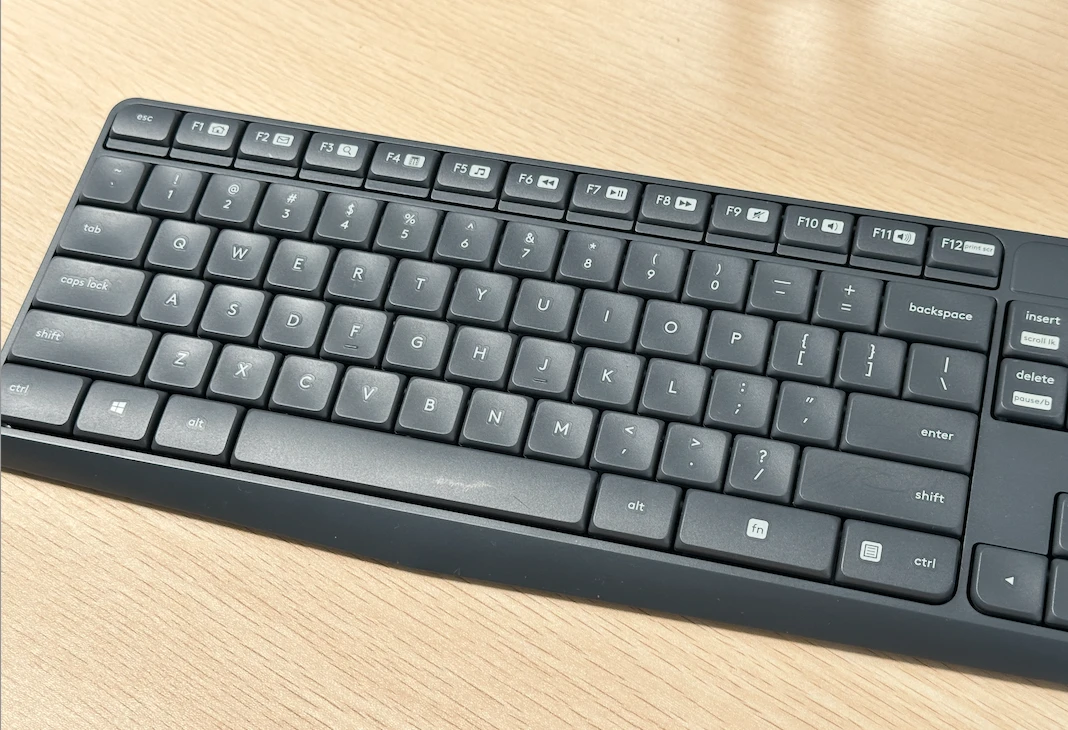
Turri's solution needed a way to check that the ink had actually transferred to the page, so he is also credited with inventing carbon paper specifically to make his machine work. Six decades later, a commercially successful version by Christopher Sholes introduced the QWERTY key layout, and the typewriter went on to dominate offices worldwide for over a century. Every keyboard in front of a sighted, able-bodied typist today, including the one this text was written on, descends from a machine built to solve one blind woman's very particular problem.
Learn more about the history of the keyboard: History-Computer.com